Vocabulary apps drill words out of context. People memorize lists, forget them a week later and quit.
Huma teaches words inside a story: a legend from a real place, told with illustrators from different countries and, alongside them, video and AI-made pieces. Each new word appears where it matters.
What I built
01StoryA legend from a real place, one chapter at a time
02Words in contextTap any word, hear it, keep it
03ReviewSpaced repetition on what you kept
04ProgressStreaks and a map of visited places
Key decisions
Native SwiftUI instead of cross-platform
why
Reading and audio have to feel instant. Native gave the smoothest text rendering and offline playback with the least code.
cost
Android has to wait.
Convex as the backend
why
Realtime sync of progress between devices came for free, and the schema lives next to the client code.
cost
A smaller ecosystem than Postgres; I keep the data model simple on purpose.
Stories before features
why
Every release ships at least one new legend. The content is the product; features follow what readers ask for.
Illustrators from each place, not one house style
why
A legend from Ecuador should look Ecuadorian. Local artists bring that; video and AI-made pieces fill the gaps and keep the release pace.
cost
Less visual uniformity across stories, more coordination.
Music app that reached more than 400k downloads, built natively in Java when that was the top of Android.
role
Android developer
period
2016 — 2018
platform
Android
stack
Java · AWS · Google Cloud · Firebase
400k+downloads
$25k+revenue
Javanative Android
The product
One of my first apps on Google Play, with several versions, and one of the most popular I have ever shipped. It did five things well:
Music download
Offline player
Automatic cover art lookup
Metadata search
Lyrics
Reach
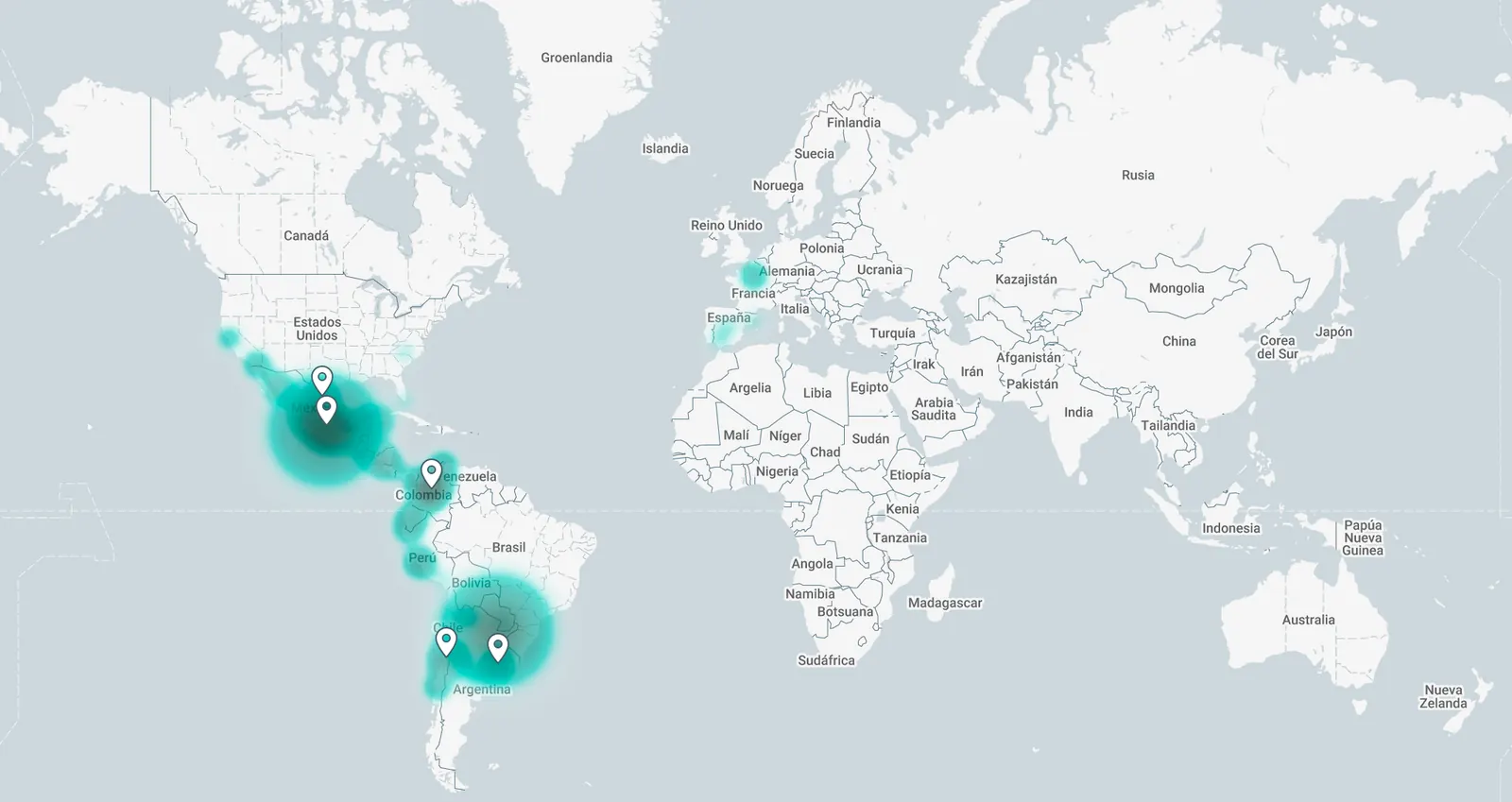
Interactions captured in real time: each pin is someone using the app at that moment. Latin America carries it, with Spain, France and the US behind.The countries with the most downloads.
Google banned me
Read the policies. I was young and built the app people wanted, but it broke some Google Play rules. I did not measure that risk, and Google closed my developer account for good. A hard hit while I was still learning.
What it left
Good earnings and a bigger lesson. After this I moved into the web: frontend, backend, servers. With Google Play closed to me, mobile had to wait a while.
The icon
The red alternative explored for the icon. The blue one shipped.
A run of small Android games built with Unity: Relax Puzzle, Chicken vs Cats, Perro Cobarde and The Little King.
role
Game developer
period
2017 — 2018
platform
Android
stack
Unity · Firebase · Google Cloud
The games
Four small Android games shipped in a row, all built with Unity: Relax Puzzle, Chicken vs Cats, Perro Cobarde and The Little King. Short sessions, simple mechanics, and a lot learned about finishing and publishing.
Relax PuzzleThe Little King
What stayed
Shipping beats polishing: each game went to the store in weeks, not months.
Unity’s component model shaped how I still think about UI state.
The store listing, icons and screenshots mattered as much as the gameplay.
New BrandBrand exploration for Huma Legends.Huma Character A/B TestTwo directions for the main character, side by side.Illustration 03Illustration 04CantuñaCover for the story of Cantuña.First IllustrationSkull and sword, in two blues.Huma Legends iconApp icon for Huma Legends.Memory ClickStudio iconApp icon for Memory ClickStudio.DeliveryCat iconApp icon for DeliveryCat.The List iconApp icon for The List.Zodiac iconApp icon for Zodiac.Chicken vs Cats iconGame icon for Chicken vs Cats.The Little King iconGame icon for The Little King.The Little King logoWordmark for The Little King.Relax Puzzle logoWordmark for Relax Puzzle.Trendy Music iconApp icon for Trendy Music.Madeira CliffsClouds wrapping the ridge before the sun opened the valley.CaliforniaA quiet frame under the flight line with the city opening behind.Blue ValleyA clear mountain basin with the horizon holding just one color.MaltaA narrow corridor of facades, cables and banners in late light.Ohrid, MacedoniaA single mast crossing the calmest part of the afternoon sea.Green RiseA softer slope where clouds break just above the tree line.Stone StepsTexture, repetition and a monochrome path cut into the rock.Harbor SilenceA narrow frame where water and distant relief almost flatten out.
04 — lab
Teaching is learning twice.
In development
Prototypes built for real, and behind them the system design and the interview exercises, solved step by step in my own words.
A spatial, infinite canvas for notes, images and ideas. Think out loud in two dimensions instead of a list.
source
Own product
stack
Next.js · React · TypeScript
tags
canvas · notes · spatial UI
What it is
An infinite canvas where notes, images and ideas live wherever you drop them. Pan, zoom, cluster. The layout is the thinking.
Why a prototype
It mixes both sides of the Lab: the system design of a canvas that stays fast with thousands of items, and the small algorithmic exercises inside it, hit testing, culling, spatial indexing.
A globe of the places I have lived in and travelled to, each stop with its own page, like stamps in a passport.
source
Own product
stack
Next.js · React · TypeScript
tags
globe · WebGL · travel
What it is
A draggable globe with a marker per place. Pick a country to fly there; pick a marker to open its stamp: where, when, one line about it.
Why a prototype
Rendering a globe smoothly on a phone is a system design problem in miniature: what to draw, when, and how to keep the frame budget. The camera easing and the marker projection are the exercises.
Users upload PDFs, every page is a call to an AI provider. One user works, three break it. Five cases, with diagrams and measured numbers, and a lab you can run.
source
Own case · production incident
tags
token bucket · work queue · AI providers · backpressure
Users upload PDFs. Every page is one call to an AI provider that extracts and structures the text. A book is a hundred pages, so one upload is a hundred calls.
Me alone, uploading three or four books one after another: fine. All pages in parallel: still fine. Then we opened it to everyone, a huge queue formed, and the provider said no.
The provider in the lab is a stand-in with the limits real ones have: 1,500 requests and 300,000 tokens per minute, 200 calls in flight at most, three dollars per million tokens. A page is about 800 tokens and takes about two seconds. Nothing leaves your machine and nothing costs money.
Case 1 · One user, one page after another
The first version. A user uploads a book and we process it page by page: send one page, wait for the answer, send the next. One call in flight per user.
One call in flight. Safe, and slow: about three and a half minutes per book.
for (const page of book.pages) { await provider.complete(page) // one after another}
It works and it is safe. The provider sees one call every two seconds and nobody complains, because nobody else is using it yet. Run case 1
Case 2 · All pages at once, and a few more users
Three minutes per book is too slow, so we fire the hundred calls together with Promise.all. One user: the book finishes in seconds. Then two, three users try at the same time. Every user is now a burst of a hundred calls and eighty thousand tokens.
Three books at once are 300 calls against 200 allowed in flight, and 240k of the 300k tokens per minute.
await Promise.all(book.pages.map((page) => provider.complete(page)))// 100 calls at once per user; nothing slows them down
The provider answers 503 Overloaded for what does not fit in flight and 429 Too Many Requests with a retry-after once the minute’s tokens run out. Pages die, the user sees a broken book, and we still pay for every page that got through.
Measured: with three users it breaks in the first second. In fifteen seconds, 2,122 pages died at the provider, 3 of 25 books came out clean, and the bill was $0.90 for pages that mostly ended up in broken books. This is the day we opened it. Run case 2
Case 3 · A rate limiter in front: the token bucket
First fix: never let more through than the provider accepts. Two buckets. One per user, small, five pages in a burst and two more per second, so one person cannot flood us. One global, pinned to the provider’s requests per minute, so the sum of everyone never exceeds it. A page takes a token from both or is refused by us, instantly and for free, with our own 429.
Two gates. Whatever does not fit is refused by us, before it costs anything.
A bucket is two numbers per key and lets a user burst a few pages, which is how people actually behave. A fixed per-minute counter is simpler but lets twice the limit through at the minute boundary.
cost
Bursts up to the bucket size are allowed by design.
The same bucket as a Lua script in Redis when there is more than one API instance
why
Read, refill and take must be one atomic step or two instances spend the same last token. Redis runs the script whole, and its own clock removes skew between servers.
cost
Logic lives in a Lua string. Keep it short and test it alone.
The provider never sees the excess again: zero 429 on their side, zero wasted spend. But the failure only moved. Now it is our limiter answering 429 to real people, and a book of a hundred pages against a bucket of five still comes out broken. Good for protecting a paid API; not enough for this product. Run case 3
Case 4 · A work queue: say yes, later
The users are not abusing anything; they are uploading books, which is the product. So instead of saying no, hold the page and send it when the provider can take it.
Two budgets because the provider has two limits. Fairness between users. A door that says no early when the wait would be absurd.
// the dispatch loopwhile (inFlight < concurrency && queue.size > 0) { const job = peek(nextUserInTurn()) if (requestBudget < 1 || tokenBudget < job.tokens) break // wait for the next token requestBudget -= 1 tokenBudget -= job.tokens dispatch(take(job))}// at the door: if (estimateWait(job) > maxWaitMs) reject busy(position)
Drain on two budgets, requests and tokens
why
Providers limit both, and a page is heavy in tokens. A queue that only counts requests would still hit the token ceiling.
cost
You need an estimate of tokens per job before sending it. For pages, the size of the text is a good enough proxy.
Round-robin between users, not first come first served
why
One user uploading ten books must not delay everyone else by ten books. A lane per user and a turn each keeps the wait proportional to what you asked for.
cost
More bookkeeping than a single FIFO.
Backpressure at the door
why
Accepting work you cannot finish in reasonable time is worse than a fast no. The queue estimates the wait on entry and refuses past a minute, with a position so the client can decide.
cost
Some users get busy on a spike even though the system is healthy. That is the point: it is honest.
No provider errors, no wasted spend, and users get waiting instead of failing: a page might take twenty seconds, but the book arrives whole. The honest part shows up too: the queue protects the provider, it does not create capacity. When more books arrive than the provider can process per minute, the wait grows until the door starts saying busy. Past that point the answer is a bigger tier or more keys, and the numbers tell you exactly when. Run case 4
Case 5 · What actually happened: the queue nobody designed
In production there was no queue and no limiter. So where did “a huge queue formed” come from? From the HTTP client. Every client library keeps a connection pool; ours allowed a couple of hundred connections to the provider. When thousands of pages arrived at once, they did not fail immediately: they waited for a free connection, in a queue we never wrote, with no fairness, no budget and no door. Latency climbed to minutes, users retried, the pool filled again, and when pages finally reached the provider they hit its limits anyway.
There is always a queue. The only choice is whether you designed it.
Cases 3 and 4 are the same waiting, made explicit and given rules. That is the whole lesson: there is always a queue; the only choice is whether you designed it.Run case 5
Where it breaks
The lab has a ramp that adds users every three seconds, 1, 2, 3, 5, 8, 12, 20, 30, 50, 80…, and notes the first failure. With all pages at once and nothing in front, it broke with 3 users at second 7, on tokens per minute. With the same crowd and the limiter, the provider stayed clean and our own 429 started at the same point. With the queue, nothing failed at the provider; the wait grew instead, and the door started saying busy when it would have passed a minute.
What I would do in production
Pages one after another per user was never the answer; parallel with a queue in front is.
Size the queue’s budgets from the provider’s documented limits, not from guesses, and alert when the wait p95 crosses a threshold: that is the signal to buy a bigger tier.
Show the position in the queue to the user. Waiting with a number is fine; waiting in the dark is what makes people retry and make it worse.
Treat the HTTP client’s pool as a queue you own: size it, measure it, and never let it be the only thing between you and a 503.
Get and put in constant time with a hash map pointing into a doubly linked list.
source
LeetCode 146 · classic interview
tags
hash map · linked list · caching
O(1)time
O(capacity)space
The problem
Design a cache with a fixed capacity. get(key) returns the value or -1. put(key, value) inserts or updates. When the cache is full, evict the item that was least recently used. Both operations must run in O(1).
Questions I would ask first
Does get count as a use? Yes: reading refreshes the item.
Does updating an existing key count as a use? Also yes.
Capacity of 0? Treat as always empty.
Single thread? For the interview, yes. See “in the real world” for the rest.
Brute force
Keep an array ordered by recency. get scans it (O(n)), moves the hit to the front (O(n)). put does the same and pops the tail when full. Correct, and too slow: every operation touches the whole array.
Where it hurts
Two things need to be fast at once: finding a key and moving an item to the front. An array finds slowly and moves slowly. A hash map finds fast but has no order. A linked list moves fast but finds slowly.
The key idea
Use both, and let each do the one thing it is good at.
01Hash mapkey → node, O(1) lookup
02Doubly linked listmost recent at the head, least at the tail
03Sentinelsfake head and tail so no edge cases on insert or remove
A get looks the node up in the map, unlinks it and relinks it at the head. A put on a new key links a node at the head and, if over capacity, drops the tail node and deletes its key from the map.
Solution
class Node { constructor( public key: number, public value: number, public prev: Node | null = null, public next: Node | null = null, ) {}}class LRUCache { private map = new Map<number, Node>() private head = new Node(0, 0) // sentinel: most recent side private tail = new Node(0, 0) // sentinel: least recent side constructor(private capacity: number) { this.head.next = this.tail this.tail.prev = this.head } get(key: number): number { const node = this.map.get(key) if (!node) return -1 this.moveToFront(node) return node.value } put(key: number, value: number): void { const existing = this.map.get(key) if (existing) { existing.value = value this.moveToFront(existing) return } const node = new Node(key, value) this.map.set(key, node) this.linkAtFront(node) if (this.map.size > this.capacity) { const victim = this.tail.prev! this.unlink(victim) this.map.delete(victim.key) } } private unlink(node: Node) { node.prev!.next = node.next node.next!.prev = node.prev } private linkAtFront(node: Node) { node.next = this.head.next node.prev = this.head this.head.next!.prev = node this.head.next = node } private moveToFront(node: Node) { this.unlink(node) this.linkAtFront(node) }}
Complexity
get and put are a map lookup plus a constant number of pointer changes: O(1). Memory is one node per entry plus the map: O(capacity).
Variants worth knowing
LFU (least frequently used): a map of frequency → its own LRU list, plus a minFreq counter. Still O(1), twice the bookkeeping.
TTL: store an expiry per node and treat expired hits as misses; evict lazily on access.
JavaScript shortcut: Map keeps insertion order, so delete + set moves a key to the end. Shorter code, same complexity, and worth mentioning before writing the list by hand.
In the real world
Redis implements approximate LRU by sampling a few keys instead of keeping an exact list: exactness is not worth the memory per key. HTTP caches and CPU caches do the same trade. The interview answer is the exact version; production usually is not.
A small interactive that shows both strategies reacting to the same stream of events.
source
Own idea
tags
JavaScript · events · UI
What it will show
Move the pointer across a strip. Three rows draw the events: the raw stream, the debounced output, and the throttled one. Sliders change the wait time and switch leading and trailing edges.
Why
Both words get used for each other in code review. Seeing the two rows side by side settles it faster than a definition.
Vocabulary apps drill words out of context. People memorize lists, forget them a week later and quit.
Huma teaches words inside a story: a legend from a real place, told with illustrators from different countries and, alongside them, video and AI-made pieces. Each new word appears where it matters.
What I built
01StoryA legend from a real place, one chapter at a time
02Words in contextTap any word, hear it, keep it
03ReviewSpaced repetition on what you kept
04ProgressStreaks and a map of visited places
Key decisions
Native SwiftUI instead of cross-platform
why
Reading and audio have to feel instant. Native gave the smoothest text rendering and offline playback with the least code.
cost
Android has to wait.
Convex as the backend
why
Realtime sync of progress between devices came for free, and the schema lives next to the client code.
cost
A smaller ecosystem than Postgres; I keep the data model simple on purpose.
Stories before features
why
Every release ships at least one new legend. The content is the product; features follow what readers ask for.
Illustrators from each place, not one house style
why
A legend from Ecuador should look Ecuadorian. Local artists bring that; video and AI-made pieces fill the gaps and keep the release pace.
cost
Less visual uniformity across stories, more coordination.